Thursday, November 8, 2007
Who's the leading Blogger?
As I was researching on my genre, which is global warming (environment), I found a couple of interesting blogs. However, one of the blogs that actually caught my eye was called, "Environment: Global Warming or Greenhouse Effect?" The website to the blog is: http://epiac1216.livejournal.com/192114.html. Why is that? Well, first of all, the blogger’s page is highly popular due to the total amount of visits it has had, which was 14,056. The average page views for this blog reported daily are 23 with 159 hits this week alone. Now that is impressive. I wish my blog could be as popular as this one. Anyways, as I read throughout the blog, I found the information very informative and interesting. I actually learned a few things myself from this blog. I noticed that this person does not just define the greenhouse effect and global warming, but also talks about the history. For example, the blogger explains the history of the greenhouse effect and who discovered it. Not just that, but every paragraph talked about something different, which is probably why the audience does not get bored. The blogger provides a ton of information, but provides it in a way that the readers can understand easily. I really think this blogger did a good job on the blog because he does go into so much detail about one topic, but actually gives an overall description of what is going on. When reading this blog, it does not just seem like the person is writing a whole bunch of information down just because he/she has to, but it really does sound like the person is very much interested in their topic and discussion.

Tuesday, November 6, 2007
Melting Glaciers

There are numerous effects of global warming such as heat waves, warm weather/wild weather. However, one of the biggest effects that global warming has seriously caused is glaciers melting not just in the United States, but worldwide. Not many people know that there is about 10 percent of the earth's land that is actually covered with glaciers. Not just that, but the glaciers hold 75 percent of the world's fresh water(Britt 2005). According to scientists on National Geographic, “The melt rate has accelerated dramatically since the mid-1990s, which was the hottest decade in a thousand years”(Boyd 2002).
No matter what part in the world, the truth is that ice is melting all over the planet. It is normal for glaciers to melt or shrink from time to time, yet when the glaciers start melting at a faster pace than they should be, something is definitely wrong. I cannot write about all of the glaciers that are melting throughout the world, but I did find some research online to give a brief overview on what’s happening around the world. According to a geologist named Lonnie Thompson told National Geographic News that Qori Kalis, a glacier in the Peruvian Andes, is melting the same amount of ice in one week when it actually used to take a whole year. Not just that, but the glaciers located in Alaska are also melting away quickly. According to glaciologist Anthony Arendt, Alaska is losing an average thickness of 6 feet per year. As scary as it is, the numbers of glaciers that have been melting are now 160,000 (Boyd 2002).
The thinning of ice is occurring all over the world such as Antarctica, Africa, Siberia, Montana, and even Venezuela. According to Time, since the last twenty years, Antarctica’s annual melt season has increased up to three years. Secondly, Africa’s tallest peak, Mount Kilimanjaro has actually lost about seventy-five percent of its ice caps. Since there is twenty-five percent of ice caps left in the mountain, there is a huge possibility that Mount Kilimanjaro could totally disappear in about fifteen years. Thirdly, eastern Siberia’s Lake Baikal has changed dramatically due to global warming from how it was a century ago. It is now being said that a century ago, winter used to occur at normal times. But now, winter occurs eleven days later in Lake Baikal. Along with that, Time has also predicted that Glacier National park will lose all of the glaciers by the year 2070. Lastly, the glaciers on Venezuelan mountaintops are also melting away. Until 1972 and now, there has been a decrease in the number of mountaintops in Venezuela. There are only two glaciers left on the Venezuelan mountaintops today when there actually used to be a total of six glaciers.
Unfortunately, these are only one of the consequences of global warming. According to the National Resources Defense Council, it is predicted that 63 years from now, which is the year 2070, all of the glaciers in Glacier National Park will be vanished. Also, if all of the ice was to melt, sea level would unsurprisingly rise to at least 230 feet (Britt 2005).It’s not just us humans who are being affected due to the melting sheets of ice which are causing rising temperatures, but also the wildlife (polar bears, penguins, seals, etc.) and plants.
References
http://www.androidworld.com/Ag_Upsala_Glacier.jpg
http://www.livescience.com/environment/050421_glacial_retreat.html
http://www.nrdc.org/globalWarming/fcons.asp
http://news.nationalgeographic.com/news/2002/08/0821_020821_wireglaciers_2.html
Tuesday, October 30, 2007
What Is Global Warming?

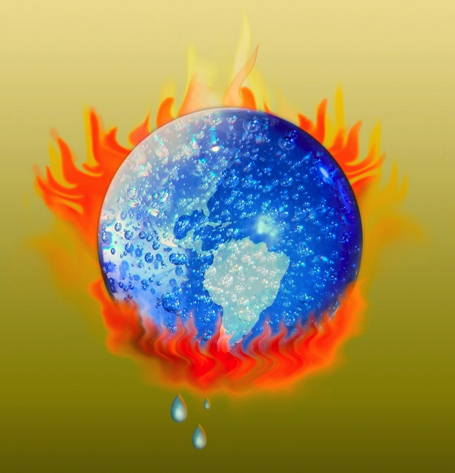
Global warming has become a severe environmental and economic issue in the 21st century. It has been known and heard of before, yet not with such importance. It is sad to say that global warming has become a threat to the entire planet. Unfortunately, the Earth is warming and consequences can or will be devastating for the future generations. The National Resources Defense Council reported,
"Although local temperatures fluctuate naturally, over the past 50 years the average global temperature has increased at the fastest rate in recorded history. And experts think the trend is accelerating: the 10 hottest years on record have all occurred since 1990. Scientists say that unless we curb global warming emissions, average U.S. temperatures could be 3 to 9 degrees higher by the end of the century."According to the United States Environmental Protection Agency, “A warming trend has been recorded since the late 19th century, with the most rapid warming occurring over the past two decades.”
As Albert Gore said, “Global warming will be the greatest environmental challenge in the 21st century.” During the past few years, the concern about global warming has increased tremendously. All of a sudden, global warming has become a popular topic that it is talked about all over the world. Why? Well, the signs of global warming are all around us, from melting glaciers to stifling heat waves. But, what exactly is global warming?
Global warming, also known as global climate change, refers to an average increase in the Earth's temperature, which in turn causes changes in climate." To simplify this definition, it basically means that the the earth is becoming hotter day by day. This happens when greenhouse gases trap heat and light from the sun in the earth’s atmosphere, which increases the temperature. This probably sounds like a lot of information to absorb at one time, so to better define the term “global warming,” one must first understand the process of “The Greenhouse effect.” Now, what is the greenhouse effect and what does it have to do with global warming?
“The "greenhouse effect" refers to the natural phenomenon that keeps the Earth in a temperature range that allows life to flourish. The sun's enormous energy warms the Earth's surface and its atmosphere. As this energy radiates back toward space as heat, a portion is absorbed by a delicate balance of heat-trapping gases in the atmosphere among them carbon dioxide and methane—which creates an insulating layer. With the temperature control of the greenhouse effect, the Earth has an average surface temperature of 59°F (15°C). Without it, the average surface temperature would be 0°F (-18°C), a temperature solow that the Earth would be frozen and could not sustain life.”The greenhouse effect and global warming are closely related. It is said that:
“Greenhouse gases in the atmosphere act like a mirror and reflect back to the Earth a part of the heat radiation, which would otherwise be lost to space. The higher the concentration of greenhouse gases like carbon dioxide in the atmosphere, the more heat energy is being reflected back to the Earth.”
Tuesday, October 23, 2007
Introduction to topic!!
On the first day of English 112, we (students) were told to come up with a “newsworthy” topic to talk about and discuss throughout the eight weeks of class. Well, the first thing that came into my mind was “Global Warming!” Then I became double-minded and thought that “Unemployment Rates” would be something that I could discuss as well. Then, when I tried to think about what I would need to write for “Unemployment Rates,” it didn’t seem as if it was such a big issue compared to global warming. When I compared the two topics, I actually came up with more information about “Global Warming” then I did about “Unemployment Rates.” But then again, the first topic seemed to interest me more and I thought that there could be more of a continuous discussion on global warming. Also, I wanted to pick a topic that would not bore me or my classmates.
Now the main question, “Why does this specific topic interest me so much?” Well, Global warming does not only affect me or my family, but the entire world. This topic has always interested me because change is not taking place every day, but every second on this planet. There are major changes that are taking place today and I have always been curious to figure out how and why. Whenever I turn on any type of news channel, the greenhouse effect and global warming are issues that are talked about on and off.
What people don’t realize is that they say that they know global warming is occurring, but yet they don’t realize why global warming is occurring and what that means. Global warming is really a matter of great concern and unfortunately, it is looked at as a very light problem. The attention to this issue is not drawn, but now I have a full opportunity to provide little or at least some knowledge about this topic and I will take the advantage fully.
Now the main question, “Why does this specific topic interest me so much?” Well, Global warming does not only affect me or my family, but the entire world. This topic has always interested me because change is not taking place every day, but every second on this planet. There are major changes that are taking place today and I have always been curious to figure out how and why. Whenever I turn on any type of news channel, the greenhouse effect and global warming are issues that are talked about on and off.
What people don’t realize is that they say that they know global warming is occurring, but yet they don’t realize why global warming is occurring and what that means. Global warming is really a matter of great concern and unfortunately, it is looked at as a very light problem. The attention to this issue is not drawn, but now I have a full opportunity to provide little or at least some knowledge about this topic and I will take the advantage fully.
Thursday, October 18, 2007
Global Warming Websites!
Browsing and searching through tons of websites, I finally found three websites that could probably be useful to me. They are:
http://managingwholes.net/?p=22
http://global-warming.accuweather.com/
http://calitics.com/showDiary.do?diaryId=4174
I thought these three blog websites were very useful due to the information provided. All three of the blog websites provide different and detailed information/knowledge. Not just that, but they are very informative and easily understood. Not one website talks about the same thing, which is awesome because I get to learn different facts from different blogs. Lastly, one of the websites also includes a video which I thought was just fascinating.
Global warming does not just target a specific audience because it is talking about the entire planet. I do not think that the audience is a specific gender or a specific age. Instead, I really think that the audience is actually the entire world. Anyone reading about global warming would not feel out of place or would not think that they do not relate to it because it concerns each and every human being on this planet.
http://managingwholes.net/?p=22
http://global-warming.accuweather.com/
http://calitics.com/showDiary.do?diaryId=4174
I thought these three blog websites were very useful due to the information provided. All three of the blog websites provide different and detailed information/knowledge. Not just that, but they are very informative and easily understood. Not one website talks about the same thing, which is awesome because I get to learn different facts from different blogs. Lastly, one of the websites also includes a video which I thought was just fascinating.
Global warming does not just target a specific audience because it is talking about the entire planet. I do not think that the audience is a specific gender or a specific age. Instead, I really think that the audience is actually the entire world. Anyone reading about global warming would not feel out of place or would not think that they do not relate to it because it concerns each and every human being on this planet.
Subscribe to:
Comments (Atom)